Echosync News - Updates and New Features
Echosync 9.0 released
Section titled “Echosync 9.0 released”Since version 8.0, Echosync has received a series of significant improvements focused on three areas: better profile organization, a clearer interface and a modernized technical foundation.
A clearer and more modern interface
Section titled “A clearer and more modern interface”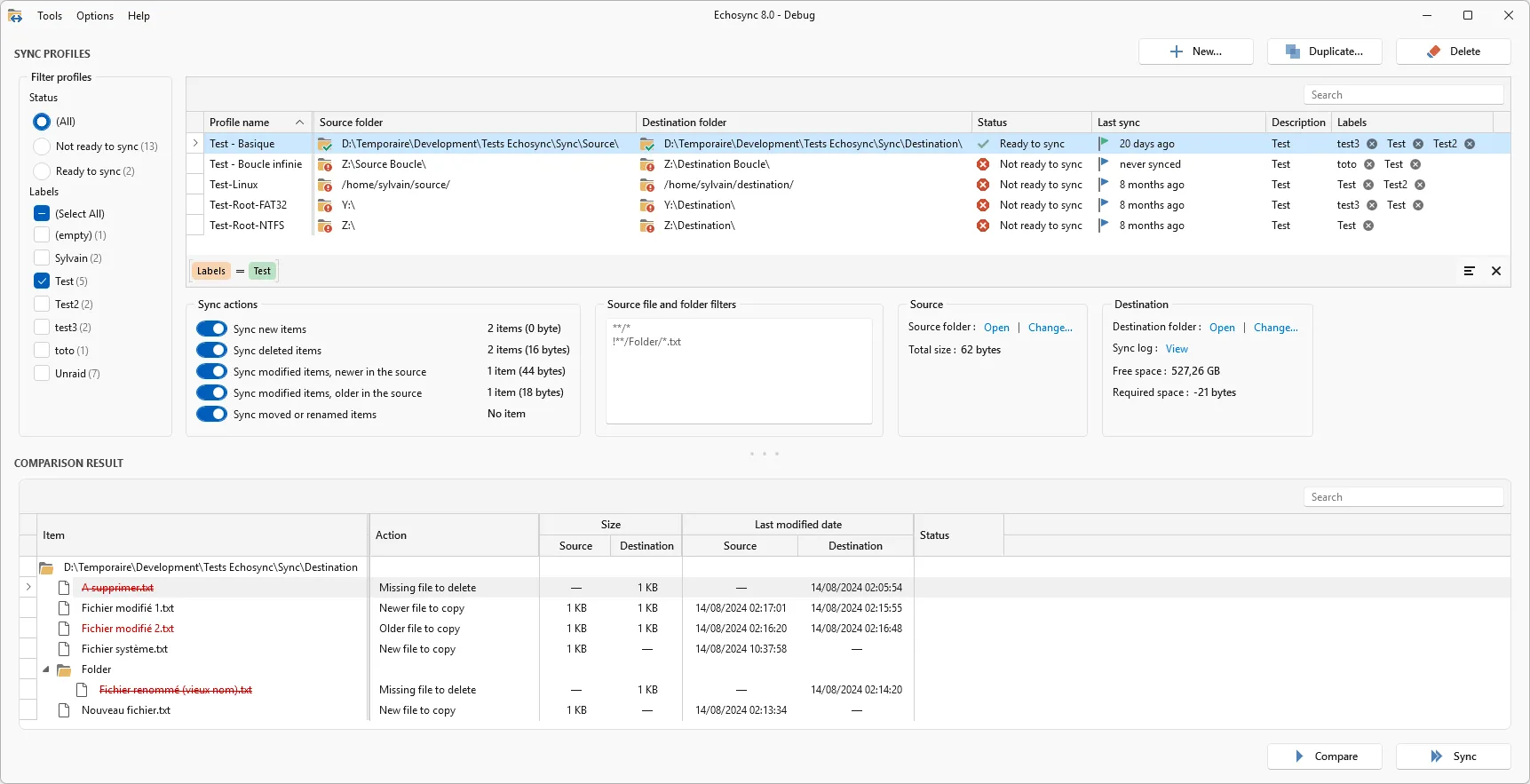
The main interface has been extensively reworked. Echosync now uses a theme aligned with Windows 11 conventions and several visual elements have been modernized: buttons with icons, clearer columns, flags indicating whether errors occurred during the last synchronization, better readability, and more consistent French and English resources.
A fixed panel at the bottom of the grid now displays details for the selected profile, with directly accessible actions: opening logs, browsing folders, changing the source or destination folder, and viewing useful profile information.
Better-organized synchronization profiles with labels
Section titled “Better-organized synchronization profiles with labels”The most notable functional addition is label support for synchronization profiles. Each profile can now be associated with one or more labels, making it easier to organize profiles by category (use case, customer, machine, context, execution frequency, etc.). This is similar to the feature available in Gmail.
These labels can be used as filtering criteria in the Echosync interface. Labels also work from the command line, with both Echosync (/label argument) and Echocli (--labels argument). This makes it possible to act on logical groups of profiles without having to select them by name (e.g. echocli list * --labels pro personal).
A new file format for profiles
Section titled “A new file format for profiles”Profile storage has moved to a single SyncProfiles.json file, which is lighter and easier to read than the old per-machine .xbp files.
Backward compatibility with older profiles is ensured: Echosync automatically converts existing .xbp files to the new format.
More information before synchronizing
Section titled “More information before synchronizing”Echosync now displays more information after a comparison:
- the total size of the source;
- the free space available on the destination;
- the space required by the operations to perform.
This information makes synchronizations more predictable and reduces the risk of launching a synchronization without enough visibility into the required disk space.
Russian and German are no longer available
Section titled “Russian and German are no longer available”The person who translated the German resources wished to step down, so a successor is now needed. German speakers willing to take over and keep the German translation of Echosync up to date are invited to register on crowdin.
As for Russian, the Crowdin website used by Echosync to manage its translations is no longer accessible from Russia due to the U.S. sanctions following Russia’s aggression against Ukraine.
June 12, 2026
Release of Echosync 8.0
Section titled “Release of Echosync 8.0”A new major version of Echosync is available.
The main new feature is the addition of an advanced mechanism for including or excluding files and folders to be synchronized. It is now possible to define filters based on “glob” patterns. These filters can be combined to create very specific synchronization profiles. Here is an overview of the glob filter syntax:
*(asterisk): matches zero or more characters in a single path segment (does not cross folder separators). Example:*.jsmatches all files ending with “.js” in the source folder.**(double asterisk): matches zero or more directory levels. It is used to perform a recursive match. Example:src/**/*.tsmatches all “.ts” files in the “src” folder and its subfolders, regardless of the depth of the tree structure.?(question mark): matches any single character (in a path segment). Example:file?.txtmatches the files “file1.txt” and “fileA.txt” but not “file12.txt”.[abc](character class): matches any character listed. Example:file[ab].txtmatches the files “filea.txt” or “fileb.txt”. It can be inverted with the negation character!placed at the beginning of the class, for example[!abc].[a-z](range): matches a character in the specified range (in this case, all letters from a to z). It can be inverted with the negation character!placed at the beginning of the range, for example[!a-z]. Intervals can be combined in the same pattern, for example[0-9A-Z].
Echosync determines whether the filter matches a file or a folder based on whether or not there is a folder separator (/ or \) at the end of the pattern. For example, the pattern !**/Temp/ will exclude all folders named “Temp” and their contents, while !**/Temp will exclude all files named “Temp”, regardless of their parent folder.
The default pattern, which includes everything recursively, is **/* or, more simply, **.
To define an exclusion filter, simply prefix the pattern with the negation character !. For example, the pattern !**/*.tmp excludes all “.tmp” files, regardless of their parent folder. It is also possible to specify an absolute path to the folder or file to be excluded, for example !C:/Absolute/Path/Folder/ or !C:/Absolute/Path/File.txt.
Exclusion filters take precedence over inclusion filters. Thus, if a file matches both an inclusion filter and an exclusion filter, it will be excluded from synchronization.
The case sensitivity of filters depends on the operating system on which Echosync is running; filters are case sensitive on Linux and case insensitive on Windows.
December 19, 2025
Linux version of Echocli now available!
Section titled “Linux version of Echocli now available!”Echocli, the command-line version of Echosync, is now available for Linux. It is available for download as a TAR.GZ archive.
September 22, 2025
Microsoft makes it easy to synchronize folders with smartphones
Section titled “Microsoft makes it easy to synchronize folders with smartphones”Microsoft has integrated a feature into Windows 11 that enables seamless access to a smartphone’s folders and files from within file explorer. To activate this feature, go to Settings, Bluetooth and devices, Mobile devices and Manage devices. An option will make the smartphone’s files visible in the file explorer and therefore in Echosync.
October 6, 2024
Echosync 7.5 released
Section titled “Echosync 7.5 released”Echosync version 7.5 accompanies the arrival of summer. The improvements mainly concern Echosync’s graphical interface:
- The various elements of the interface have been redesigned for optimum legibility, whatever the chosen theme.
- Synchronization options are displayed closer to the synchronization profiles (just below the profile name).
- The various synchronization options have been clarified.
- The discoverability of the commands associated with each profile has been improved, as they are now displayed alongside the synchronization options (rather than hidden in contextual menus).
- The grid for displaying comparison results is now specific to each synchronization profile, putting an end to any latency when switching from one profile to another (when the grid is very large) and allowing you to customize the grid display (sorting, filtering) independently for each profile.
June 27, 2024
Echosync 7.2 released
Section titled “Echosync 7.2 released”As we approach the end of 2023, Echosync releases version 7.2. In addition to improvements to the loading time of the main window, Echosync now offers a wide range of themes to suit every user’s taste. Themes can be selected from the Options menu. You can switch between themes using the Alt + Left/Right keyboard shortcut, and immediately see the result.
December 18, 2023
Echosync binaries will no longer be electronically signed as of July 1, 2023
Section titled “Echosync binaries will no longer be electronically signed as of July 1, 2023”Echosync binaries have been electronically signed since version 6.0.1.1, released in July 2021. This guaranteed the integrity and origin of the software, but above all avoided the unexpected and anxiety-inducing alerts from the Windows SmartScreen filter, which is often intolerant of new and therefore unknown software (which is, by definition, the case when an update is released), then considered suspicious or even malicious.
Unfortunately, the price of code-signing certificates has quadrupled this year. As a result, the price has become unreasonable in relation to the added value provided by this guarantee of authenticity.
As Echosync does not generate any revenue, choices must necessarily be made as to the use of resources allocated to the development of Echosync.
June 16, 2023
Echosync 7 released with a command line version (CLI)
Section titled “Echosync 7 released with a command line version (CLI)”The main new feature of Echosync 7 is the availability of a command line application: Echocli.
PS C:\Echocli\bin\x64\Debug> .\Echocli.exe compare nas-software
╭─ NAS-software (3beba0ec-ebd6-4d8a-af8c-e753400eb092) ───────────────────────────────────────────────────────────────────╮│                                                                                                                         ││ Source Folder:                            D:\NAS\software\Sylvain\                                                      ││ Destination Folder:                       \\TOWER\software\Sylvain\                                                     ││ Description:                              Software synchronization to NAS                                               ││                                                                                                                         ││ Sync new items:                           Yes                                                                           ││ Sync deleted items:                       Yes                                                                           ││ Sync modified items, newer in the source: Yes                                                                           ││ Sync modified items, older in the source: Yes                                                                           ││ Sync moved or renamed items:              Yes                                                                           ││                                                                                                                         ││ Last Sync:                                2 months ago (19/02/2023 02:20:21)                                            ││ Sync Log Path:                            C:\Echocli\bin\x64\Debug\Profiles\3beba0ec-ebd6-4d8a-af8c-e753400eb092.log    ││                                                                                                                         │╰─────────────────────────────────────────────────────────────────────────────────────────────────────────────────────────╯
Warning: Traversation loop detection will not be available for [\\TOWER\software\Sylvain\].
📂 \\TOWER\software\Sylvain└── 📂 Microsoft    └── 📂 Office 2021 ProPlus        ├── 📄 ProPlus2021Retail.img → New file to copy (4 629 426 KB, 13/04/2023 23:15:38)        └── 📄 Votre clé d'activation Office 2021 Professionnel Plus (72019523).eml → New file to copy (56 KB, 13/04/2023 23:58:11)
╭──────────────────────────────────────────┬───────┬─────────╮│ Process                                  │ Count │    Size │├──────────────────────────────────────────┼───────┼─────────┤│ File or folder to rename or move         │     0 │  0 byte ││ Missing file or folder to delete         │     0 │  0 byte ││ Newer file to copy                       │     0 │  0 byte ││ Older file to copy                       │     0 │  0 byte ││ New file to copy or new folder to create │     2 │ 4,42 GB │╰──────────────────────────────────────────┴───────┴─────────╯
April 23, 2023
Echosync can be installed with winget
Section titled “Echosync can be installed with winget”Echosync can now be installed, updated and uninstalled with winget with the command winget install SylvainRougeaux.Echosync.
January 9, 2023
Echosync released in an installable version (MSI)
Section titled “Echosync released in an installable version (MSI)”Echosync can now be downloaded as an MSI package and installed on Windows.
July 25, 2022
Echosync available in Dutch
Section titled “Echosync available in Dutch”Thanks to Jeroen Westera, Echosync is now available in Dutch.
March 8, 2022
Echosync 6.1 released
Section titled “Echosync 6.1 released”Here are the main new features of Echosync 6.1:
- Add Options, Schedule and Echosync menus, for increased accessibility of commands that used to appear in a contextual menu.
- A left click in the application background allows to move the window.
- Added commands Expand All Items and Collapse All Items in the contextual menu of the comparison report lines.
- Display a progress bar during synchronization in the Status column of the profiles.
- Display an indicator to identify the item being processed in the comparison report, and even the percentage of progress in case of file copy.
- Use of a new file copy engine that supports immediate pausing while copying.
- Better performance, especially when loading profiles at application startup.
August 22, 2021
Echosync 6.0 released
Section titled “Echosync 6.0 released”Version 6.0 of Echosync was released today. The new features of this major version are essentially technical, linked to the use of the .NET 5.0 framework, now embedded in the software itself (it is no longer necessary to install it on the machine beforehand). Echosync is now a 64-bit application. Gains in performance and reliability are expected.
January 15, 2021
Echosync available in Chinese
Section titled “Echosync available in Chinese”Thanks to 王晨旭, Echosync is now available in Chinese.
October 23, 2020
Echosync considers your files as different even though they have not been modified…?
Section titled “Echosync considers your files as different even though they have not been modified…?”If a daylight saving time change has recently occurred and you are comparing files stored on an NTFS volume and a FAT volume, this is likely why. Indeed, if the modification dates of the files are saved in UTC format with NTFS, they are saved in local time with FAT, causing difficulties when making comparisons. I look forward to the abolition of daylight saving time and/or the abandonment of FAT. More information on how Windows handles timestamping files is available at this address.
April 15, 2020
Echosync available in new languages
Section titled “Echosync available in new languages”Echosync is now available in Russian, German, Spanish and Italian.
February 15, 2019
New options available on the command line
Section titled “New options available on the command line”Echosync version 5.5.4 offers the following new command line options:
- option
/exitonsuccesswhich causes Echosync to close automatically only if there is no error during synchronization operations (without displaying the cancel countdown window, just like the/exitoption now); - option
/silentwhich disables the splash screen and automatically minimizes the program window in the taskbar.
January 25, 2019
Echosync 5.5 released
Section titled “Echosync 5.5 released”Here are the main new features of Echosync 5.5:
- The ability to choose not to synchronize more recent modified files in the Destination, while maintaining the synchronization of more recent files in the Source.
- The comparison and synchronization operations can be paused (without having to undo everything and start all over again).
- Dynamic detection of insertion or removal of USB storage devices.
- Echosync’s ability to update itself automatically, without manual user intervention, via a PowerShell script.
August 22, 2018
Echosync 5.0 released
Section titled “Echosync 5.0 released”It is now possible to consult the synchronization log and exclude folders (“source” sub-folders) from synchronization in version 5 of Echosync.
On the other hand, the functionality to synchronize a folder to a VHD file is no longer available due to a lack of interest by users.
February 8, 2018
Echosync 4.0 released
Section titled “Echosync 4.0 released”Among the main new features available in Echosync 4.0:
- A unique Destination folder per profile, but the possibility to use the same VHD file in several profiles.
- Support for paths longer than 255 characters.
- The use of the volume ID to identify the Source and Destination folders (and not only the Windows volume letter or relative path, which is useful when using a USB key whose letter can change).
- Visualization of the result of the comparisons directly in the software interface with a future view of the Destination.
- The use of a new theme inspired by Office 2013.
July 31, 2013